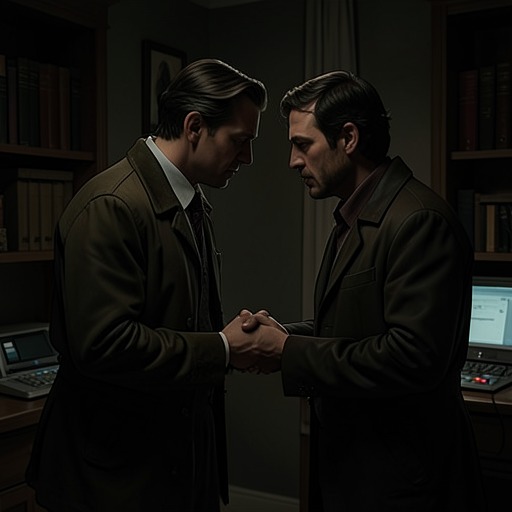
The jealous husband’s false-confession scheme
The DecameronThe jealous husband’s false-confession scheme is a story of domestic surveillance turned against its author. A merchant, convinced without cause that his beautiful wife attracts every man, restricts her movements until she resolves to take a lover. His attempt to expose her by impersonating a priest instead gives her the means to deceive him, and his watchful jealousy ends by protecting the affair it was meant to prevent.
Framing and the husband’s jealousy
Fiammetta tells the story in response to the preceding tale, presenting it as another instance in which a wife’s conduct toward a jealous husband should not be condemned. Her framing emphasizes the confinement that makes the wife’s stratagem possible: women, she argues, may be kept at home throughout the week with household duties and then denied even the ordinary rest and diversion of a holiday. Jealous husbands, in her account, make their wives’ lives more restricted and wretched still.
The story places the merchant in Arimino and identifies him as rich in both land and money. His wife is very beautiful, and he loves her exceedingly; yet that love does not make him trust her. He imagines that every man admires her and that she tries to please others as she pleases him. The narration marks this reasoning as foolish: he has no actual cause to suspect her, but treats his own assumption as grounds for confinement.
His control is extreme. His wife cannot go to weddings, entertainments, or church, and she does not dare even stand at a window or look outside. Feeling herself unjustly suspected, she decides that, if her husband insists on treating her as guilty, she will find a way to secure some solace. Her resolution is not presented as the result of an existing affair: it follows the suspicion and restrictions imposed on her.
The opening in the wall
Because she cannot show herself to passing suitors, the wife looks for an opportunity nearer at hand. A handsome, agreeable young man, Filippo, lives in the adjoining house. While her husband is away, she searches the partition wall and finds a concealed fissure that opens toward a bedroom. A maid confirms that Filippo sleeps there alone.
The wife visits the crack, drops pebbles and other small objects when she knows Filippo is nearby, and eventually draws him to the opening. Speaking softly, she tells him her mind; he welcomes her advances and secretly enlarges the hole from his side. The opening allows them to speak and touch hands, but the husband’s vigilance keeps them from meeting. The lovers therefore have a connection but not yet a route into one another’s rooms.
The false confession
As the Feast of the Nativity approaches, the wife asks to go to church on Christmas morning to confess and receive the sacrament. Her husband questions what sins she could have committed, then insists that she use their parish chapel and confess only to its chaplain or a priest he appoints. She understands enough to suspect his purpose, but agrees.
The merchant reaches the chapel before her, arranges matters with the chaplain, and puts on one of his gowns and a large, flapped cowl. To disguise his voice, he has placed pebbles in his mouth. His wife recognizes him as soon as he approaches, despite the hood and the altered speech. She pretends not to know him and makes the confession he is hoping to obtain: she says she loves a priest who comes to lie with her every night.
When the disguised husband asks how this can happen while she also shares her bed with her husband, she invents a supernatural explanation. The priest, she claims, can open every locked door and speak words that make her husband fall asleep. She says she loves this priest too much to stop seeing him. The husband, consumed by the desire to know more, continues the false confession rather than exposing himself or leaving.
He offers to pray for her and to send a little clerk to ask whether the prayers have helped. The wife cautions him not to send anyone to her home: her husband is so jealous, she says, that he would suspect the messenger of misconduct. The disguised merchant assures her that she need not fear him. By the time she leaves for mass, he believes he has learned of a nightly intruder and has promised to create a channel through which he can monitor her.
The watch at the door
After returning from church, the wife reads from her husband’s expression that the encounter has angered him, though he tries to conceal what he has done. He tells her he will sup and sleep away from home and instructs her to lock the street door, the door at the middle stair, and her chamber door. She instead signals Filippo through the familiar opening in the wall and tells him what happened. Since she expects her husband to be watching the entrance, she asks Filippo to find a way in over the roof.
That night the merchant takes his arms and hides in a ground-floor room near the street door. His wife locks the doors, including the middle-stair door, so he cannot come upstairs, and Filippo reaches her by a concealed route from his side. They lie together until daybreak; Filippo then returns to his own house. The merchant, meanwhile, waits by the street entrance for the priest he believes must arrive. He remains there nearly all night, cold and without supper, and eventually gives up and falls asleep in the ground-floor room.
Around Tierce, he wakes, finds the street door open, and pretends to return from elsewhere before going upstairs. Soon afterward, he sends a boy to the wife as though the boy were the priest’s clerk, asking whether the priest has visited again. She replies that he has not. The merchant continues keeping watch night after night, while the wife continues seeing Filippo. The deception succeeds because the husband’s own invented story has directed his attention toward the door and the imaginary priest rather than toward the lover’s actual route.
Recognition and reversal
At last the merchant angrily demands to know what his wife told the priest. She refuses at first, saying it would be neither just nor proper to reveal a confession. He threatens her and insists that she name the priest. She then explains the joke he has failed to understand: she knew at once that the priest was her husband. The confession was made for him, not to him unknowingly.
Her explanation turns each detail of the false confession back upon its author. The priest who lies with her is the husband himself; the doors that never remain locked against the supposed visitor are the doors the husband opens; and the nightly visits are his own bedtimes with her. Even the reports sent by the little clerk have a plain meaning: on the nights her husband is away from her, she tells the messenger that the priest has not come. The husband has mistaken his wife’s transparent, double-edged account for evidence of a supernatural rival.
The merchant recognizes that he has been made a fool of. Rather than punish her, he now regards her as virtuous and discreet and casts off his jealousy as quickly as he had taken it up. The final reversal is practical as well as comic: the wife no longer needs to bring Filippo in by a hidden way over the roof. She admits him through the door and continues to enjoy their affair. The confession that was meant to expose her thus becomes the instrument of her escape from surveillance, while the husband’s own disguise and suspicion leave him less able to control her than before.